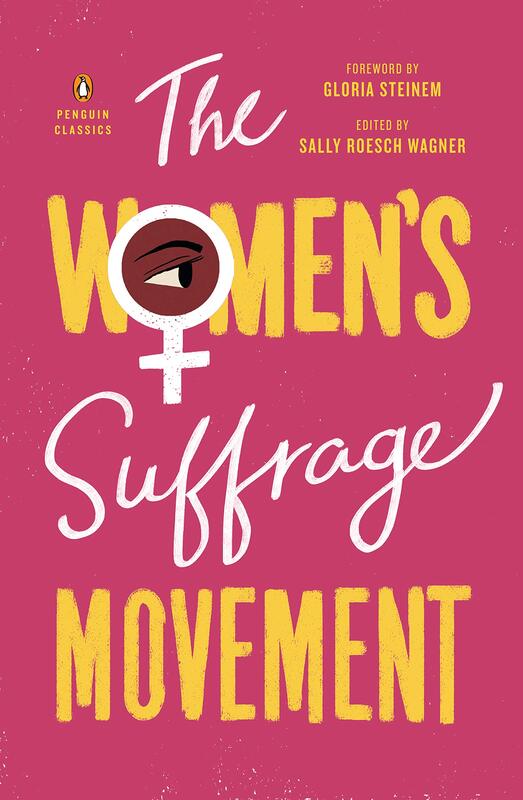
“The story of [American] women’s suffrage has been told in the same fashion for 100 years: it is familiar, repetitive, and overwhelmingly white."--from press release.
BUT... no more! There is a new history book that has just been published, and it is GLORIOUS!
Seriously. This book is a terrific read, a complete page-turner. I could barely put it down. The only reason I would put it down was that it was 500 pages long, and, periodically, I actually had to eat and sleep. I was really sad to see it end, even if it did mean we finally got the vote.
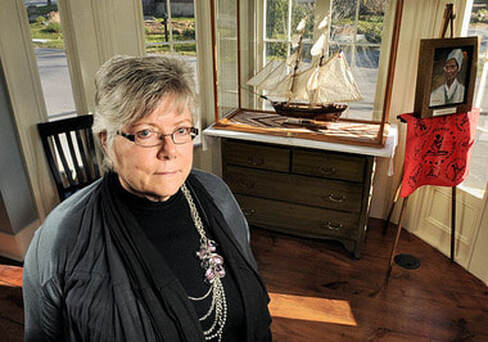 Sally Roesch Wagner executive director of the Matilda Joslyn Gage Foundation, in the Gage House that she has turned into a museum.
So how did Sally Roesch Wagner turn the history of women’s suffrage into the best beach read of the summer? I’ll let her answer:
“I was inspired by nearly 50 years of learning from my students. They taught me what stories they shared with their friends; what information impacted and empowered them; what made them angry; and, most importantly, what they had never been told.”
She gives the reader what she wants! And she also does not give her what she doesn’t want:
“I also had to avoid the impulse to replace the ‘great-men-great-wars’ narrative with a ‘great-women' one—not a task for the faint-hearted or the perfectionist.”
Sally Roesch Wagner has widened the lens of Suffrage history and refocused the narrative to include the women of color whose presence has always informed the struggle. She does not minimize or excuse the racism of white women, and this is one of the reasons why the book is such a page-turner: The divisions, the issues, the strategies of appeasement vs. radical action are heart-poundingly relevant to the divisions, issues and strategies of today. The major players find their counterparts in today’s Black Lives Matter and across the spectrum of Congressional leadership. In the words of Susan B. Anthony: “Every generation of converts [to feminism] threshes over the same old straw.”
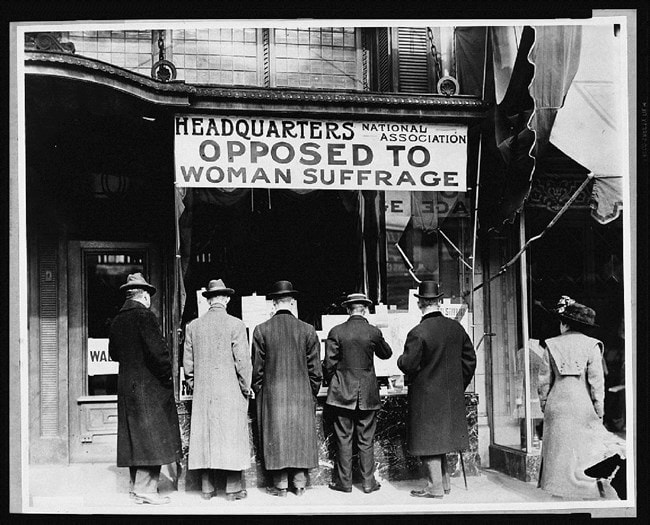
The book is packed with fascinating, complicated, passionate, flawed women practicing radical and visionary politics—and also engaging in abysmal, good-old-white-boy deals-with-the-devil. Roesch shows us the backroom trades, the rhetoric, the scandals, the pernicious impact of mixing religion with politics, and the cautionary divisions that historians have attempted to hide.
And the men! Many women have been caught off-guard by the recent tsunami of misogyny that appears to have arisen from nowhere. Well, it wasn’t “from nowhere” at all! The Women’s Suffrage Movement plunges us deep below the surface of this present wave to experience the historical, bottomless ocean of men’s hatred of women and compulsion to dominate every single aspect of our lives. There are no Sith or Terran Empires, no Necrons, Tyranids, Weeping Angels or other sci-fi villains who can compare with the fiendish forces of white men arrayed against women, and especially against women of color, in the struggle for women’s liberation.
So how does this book work?
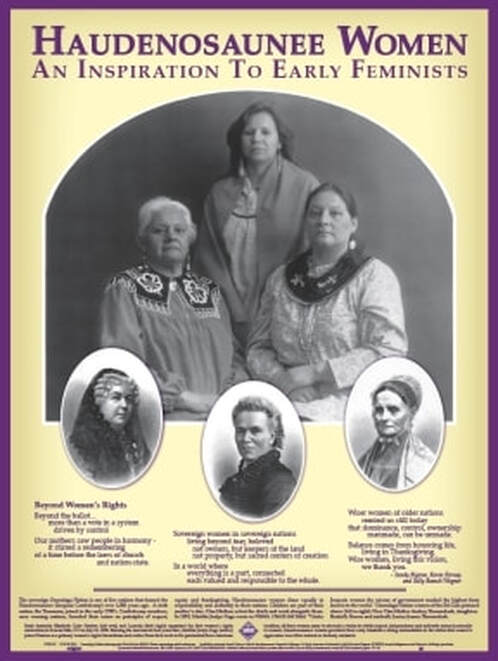 This poster is available from the Syracuse Cultural Workers at https://www.syracuseculturalworkers.com/products/poster-haudenosaunee-women
It works because it is so user-friendly. Wagner pulls us in with her first two “I-did-not-see-that-coming” chapters: “Women Voted Before the United States Was Formed” and “Women Organized Before Seneca Falls.”
Just one example. There was an informal meeting of five women on Sunday, July 9, 1848 in Waterloo, New York. History books might tells us that this was where the idea for the first women’s rights convention was birthed. *yawn*
Wagner puts us in the room with the women. Four of them had just come from a Quaker meeting. Possibly they decided to meet in the home of the woman with the two-week-old baby, because she was still nursing. A newcomer to the meeting was a mother of five children who lived at the end of a dead-end road, two miles from her nearest neighbor, with an often-absent husband. The four Quaker women all lived in homes that were on the Underground Railroad. Even as they sat there sipping, they were breaking the law. One of these abolitionist activists had traveled all the way to London to attend an abolitionist convention, only to discover they would not seat her because she was female. WOMEN WITH ISSUES.
And… one of the women had just gotten home from a month-long visit with the Seneca Nation near the Pennsylvania border, as these indigenous people debated whether or not to abandon their traditional clan-based government and replace it with with a US election system. It was not lost on her that the indigenous women had more voice, dignity, and respect under their own form of government. As they sit in the room with the new-born and her mother, they most likely discussed how the Haudenosaunee people had a visionary provision that all treaties had to be approved by three fourths of all the mothers in the nation. This provision appears to me to be an acknowledgement of the unique and very physical connection and investment that mothers have with their offspring, connection and investment that incentivizes them to priorize long-term consequences with regards to dispensation of land. And here we are today where female biology is not just considered irrelevant, but taboo to reference! I often have wished that our government had a Cabinet position, “Secretary of Long-Term Consequences” from the Department of the Future. The Haudenosaunee were on it a thousand years ago.
ANYWAY… The old history books would simply reel off the five names. Wagner puts us in the room with all of those multicultural, multi-generational, trans-European, multi-issue cross-currents swirling around our heads. THAT’s how it’s done, women. Personal frustrations, political indignities, humble acknowledgement that indigenous people have more evolved systems of government, and white women putting their freedom on the line for the liberation of people of color. Given a context like that, almost anything could be the flashpoint for revolution.
So then, after these eye-opening chapters, Wagner devotes each chapter to a decade, from the 1850’s up to 1920, when the 19th Amendment was finally passed. Bonus: At the end of each chapter, Wagner includes riveting, primary-source samples of speeches, reports, editorials and other documents from that decade. Why? As Wagner says, “Primary sources take us onto the field where we watch the action, listen to the players, and figure out for ourselves what is going on.”
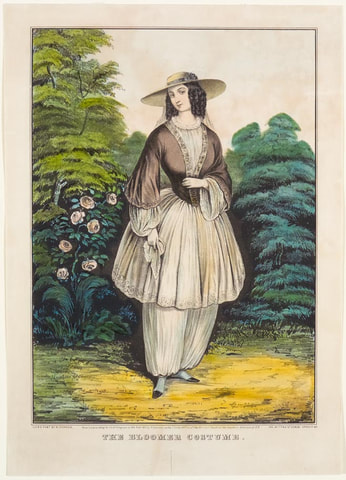
One of my favorite examples of the value of primary resources are the editorials debating dress reform. There is an obnoxious editorial by a master mansplainer, informing Suffrage women that they are forfeiting their right to all respect and credibility in his eyes (oh, no!), because they have abandoned wearing the Bloomer costume. He, of course, never wore anything in his life that would cause threatening mobs of people to follow him down the street, to throw horse manure all over him, and to subject him to endless catcalls and threats of rape everywhere he went. Elizabeth Cady Stanton cleans his clock quite handily and I savored every word she wrote.
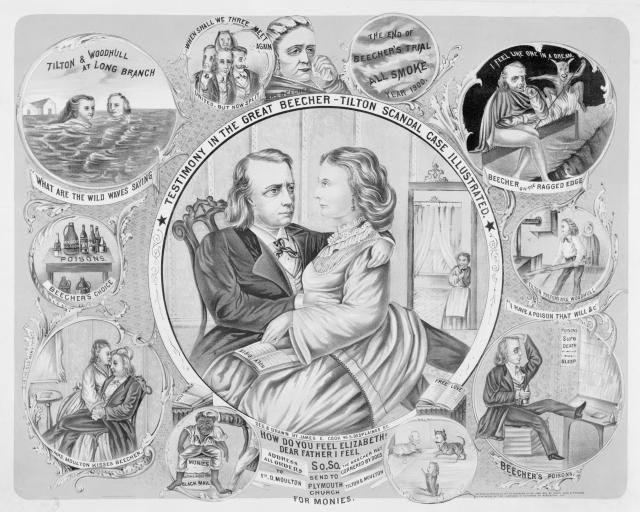 #MeToo moment, 19th-century-style.
Well… I don’t want to give too many spoilers… but in terms of relevance, there is domestic worker Hester Vaughan who either miscarried or aborted a child borne of rape, and who was given the death penalty. What saved her? Women who organized.
There is a 19th century #MeToo moment when Victoria Woodhull, slut-shamed as a "Free Love" advocate, calls out the womanizing preacher Henry Ward Beecher on his adulterous relations with a married parishioner.
There is Elizabeth Cady Stanton on the occasion of her eightieth birthday, rising to the podium and throwing out the most radical challenge of her career: making the same demands of religion that the movement has made of the State. She is an utter badass and her speech is a complete barn burner. And I am sure that half the women who had baked the cake and put up the party decorations where offended as hell. Because that's how it's done when you are eighty.
There is Alice Paul, radicalized by the militant Suffragettes in England, who wants to have a ton of parades and protests. The by-then conservative movement says, “Fine, sweetie. Just raise your own money, because we won’t give you any.” She does, and she hosts rallies and protests that are wildly, insanely successful in terms of attendance and PR… so they kick her out of the organization. Alexandria Ocasio-Cortez, I am thinking of you so hard.
There is the “you-can’t-make-this-stuff-up” melodrama of the Tennessee vote to ratify the 19th amendment. It’s the final state vote that will make it law, and it comes right down to the wire, with a senator racing the clock to cast the vote and still make it home to attend the dying of his child. He’s escorted there by the women, who then have to race back to get him. He jumps from a moving train… Dirty tricks, last minute reversals, women staying one step ahead of their enemies. Really, someone needs to make a film.
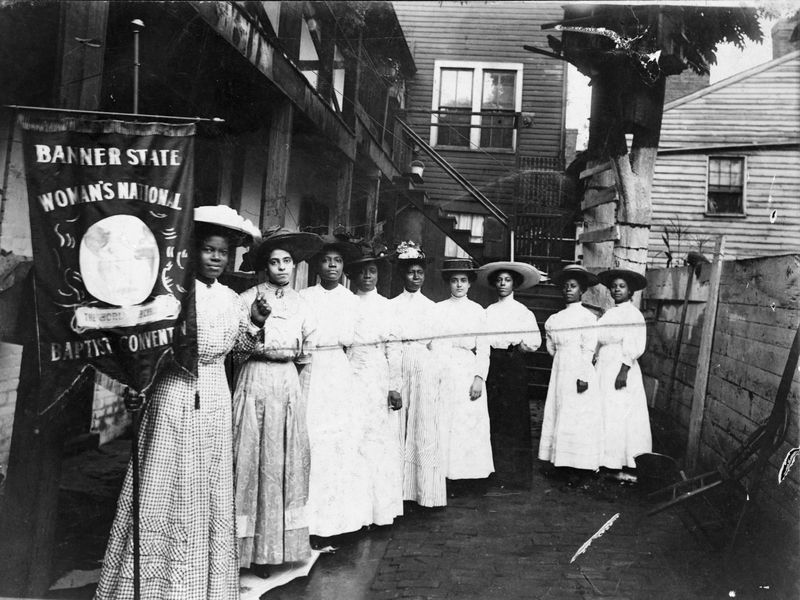 Nine African-American women gather for the Banner State Woman's National Baptist Convention in 1915 (Library of Congress Prints and Photographs Division Washington, D.C. 20540 USA)
One of the strongest through-lines of the book is white women’s betrayal of women of color in the movement. The pivotal moment happened in a midnight session of a national conference. It happened with a non-representational body of that organization. It was a dirty trick. But the groundwork for the division had been laid by complex grids of historical, social, and political matrices.
There had been the “divide and conquer” tactics of the 14th amendment. Ostensibly granting citizenship to former slaves, the amendment introduces the word “male” into the Constitution... as a qualifier for voting rights. Should the Suffrage Movement oppose this amendment, so critical to spelling out citizens' rights to African Americans, if it was going to come at the expense of women's suffrage rights... including women of color? Not surprisingly, women of color in the movement had a very different perspective from many of the white women.
And then there was the temperance movement. Their organization had twice the membership of all the suffrage parties combined. Why? As Lucy Stone put it, “It’s so much easier to to see a drunkard than it is to see a principle.” The temperance movement has been framed today as a movement made up of Miss Grundy-type Puritanical school marms. In fact, in an era when women had almost no rights, it was a movement to stem domestic violence and especially rape. It was a movement filled with battered women and victims of sexual abuse, including incest. And it was a deeply religious movement, where women were reaching for a higher power than their human lords and masters, to legitimize their claims.
Susan B. Anthony wanted their numbers, and she was willing to do whatever was necessary to join forces with the Women's Christian Temperance Union. The price was an unholy alliance with organized, conservative, deeply racist religion.
And, finally, there was an appalling level of pandering to the racism of the Southern states. Women's suffrage was sold to them as a way to counter the rising political voice of African American men in the South.
In a conversation with Sally Roesch Wagner, she is asked, “What do you think are the most important takeaways from the women’s suffrage movement for social justice movements of today?”
Here is her answer:
“Eschew expediency. I’d like to see that on a big poster on every activist’s wall, and especially on the wall of organizations. When you abandon principle in order to win, like the later suffragists did, you may indeed win the battle, but you lose the war for justice. You create a legacy of division that continues for centuries.”
This is the best reason of all the many reasons to buy and read and treasure this delightful, intrepid, RELEVANT, page-turning, truth-telling book. It offers clarity and vision for our future. Eschew expediency right now and go out and get it.
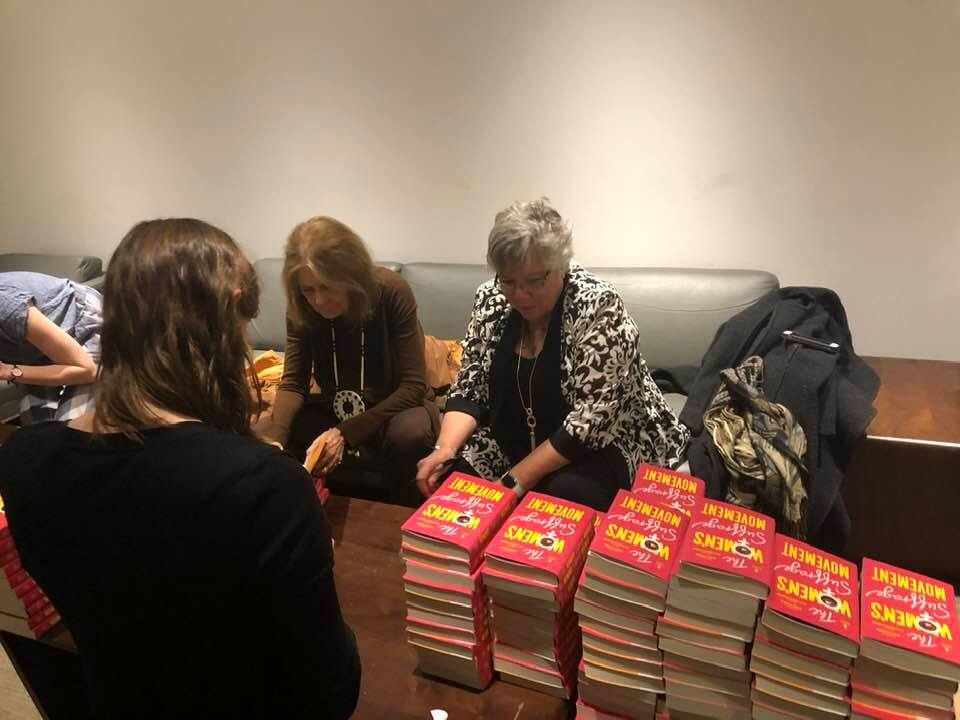
Gloria Steinem (who wrote the foreward) and Sally Roesch Wagner hard at work for a feminist future.
 RSS Feed
