Originally published in Rain and Thunder: A Radical Feminist Journal of Discussion and Activism, Issue 2, Spring 1999, Northampton, MA.
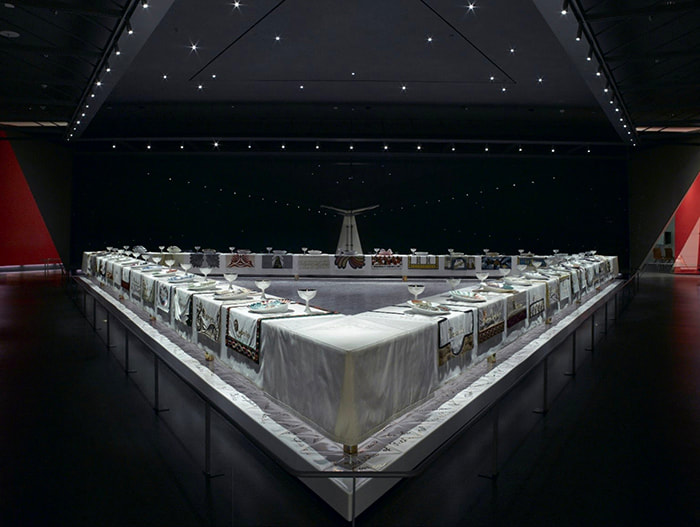
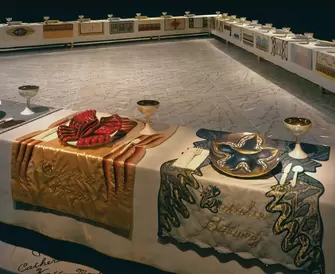
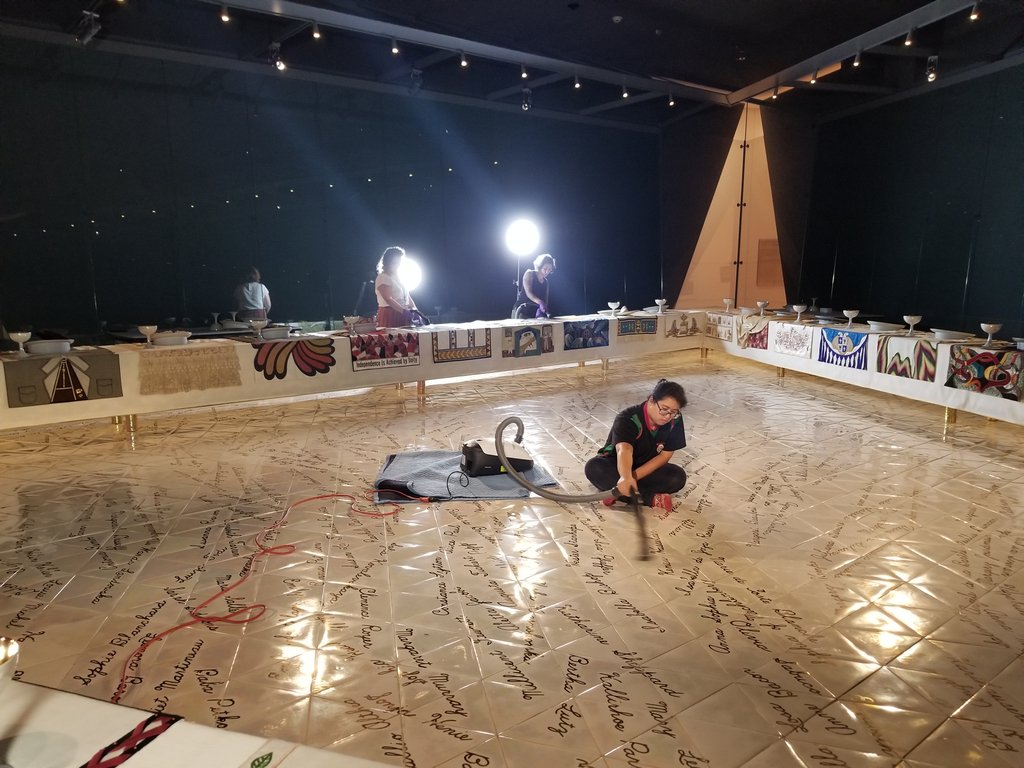
In the last issue of Rain and Thunder, Barbara Louise's plea for donations to provide permanent housing for “The Dinner Party” was published. “The Dinner Party” by Judy Chicago, a symbolic commemoration of women in history, is probably the most famous work of Second Wave feminist art in the world. From 1974 to 1979, Chicago researched the biographies of women that were just coming to light in the newly-created departments of Women's Studies. She designed a triangular table for the thirty-nine “guests,” each represented by a place setting complete with an individually designed place mat and plate. Inside the table, was the “Heritage Floor,” where tiles bearing the names of nine hundred and ninety-nine more women honored those not chosen for seating at the table.
“The Dinner Party” was a massive work, engaging the minds, hearts, and hands of dozens of women. It marked a reclaiming not only of aspects of women's history, but also of women's traditional arts, which had been considered “crafts” by a male dominant art world.
“The Dinner Party,” as with all works of art, represents the vision of its maker—a vision specific to an individual, to a place, and to a time. That time was the beginning of the Second Wave, when the movement was dominated by the interests of white and predominantly middle-class women. That place was the US, a country still struggling to catch up to the upheavals caused by the social revolutions of the 1960's. And that woman was Judy Chicago, a white woman eagerly embracing the discoveries, values, and comeraderie of that early Second Wave and courageously using her feminism to challenge the male hegemony of the commercial and academic art world. It was a time when sisterhood was powerful, but multi-culturalism was not.
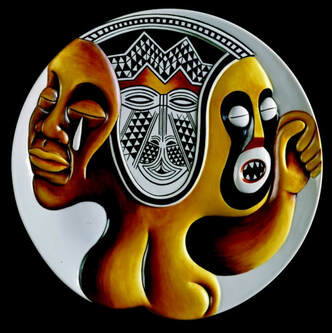 Sojourner Truth's plate
Since 1979, the women's movement has undergone changes, including a radical critique of the classism, racism, and Eurocentrism of its earlier agenda and constituency. As African American studies became more feminist-friendly and women's studies became more multi-cultural, consciousness about the marginalization of women of color in so-called “women's history” was raised. Curricula that may have appeared to be racially inclusive in the 1970's is now, in light of two decades of scholarship and publication by and about women of color, seen as painfully tokenizing.
“The Dinner Party” is an accurate reflection of the racial imbalance that characterized women's studies two decades ago, and critiques of the work that charge it with racism are valid. In a photograph commemorating the dozens of artists who contributed their work to the project, there is not one face that appears to be African American. Ironically, the book in which this photograph is published is titled The Dinner Party: A Symbol of Our Heritage.
The only African American woman invited to sit at the table is Sojourner Truth. Not just a token at “The Dinner Party,” Truth was also used as a token by the predominantly-white Suffrage Movement. The cause for which she labored stood to benefit white women more immediately than women of color, and perhaps it is for this reason that she was the first woman of color to come to mind when Chicago was drawing up her seating arrangements. Perhaps the work of women like Fannie Lou Hamer or Harriet Tubman was seen as too specific to African Americans to warrant the one place at the table with so many white women.
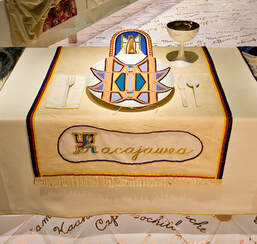 Sacagawea's place setting
In addition to calling attention to her token presence, African American critics of “The Dinner Party” have raised objections to the plate design for Sojourner Truth. The other dinner guests have plates whose designs represent fanciful abstractions on the theme of the vulva, but Truth's plate is distinctly “other” and “exotic,” in that it has stylized human faces, not vulvas, on it. Critics have noted a “mammy-esque” treatment of the African American woman's face on this plate, which was overtly designed to represent an African mask and the agony of enslavement. This refusal to ascribe a vulva design to Sojourner Truth has been read as a racist denial of, or discomfort with, the African American woman's sexuality, a flip-side—or perhaps overreaction—to the traditional stereotype of Black women as oversexed.
Chicago does include the names of other Black women among the 999 names on the floor tiles, but this roster is still dominated by white women of European background.
The only First Nations woman at the table is Sacajawea, again a collaborator with white—and, this time, colonial—interests. Although the goddesses represented at the table are multi-cultural, the actual historical guests do not include any Latinas or Asian women.
Where do we go from here? Should we abandon “The Dinner Party” to the warehouse where it has been ignominiously stowed all these years—a response not to its lack of racial inclusiveness, but to its aggressive feminist content. Do we, for the good of some supposedly overriding cause, gloss the racism inherent in the token presence of women of color at the table?
Is it possible for a work of art to be considered great, when, at the same time, it reflects and perpetuates racist values?
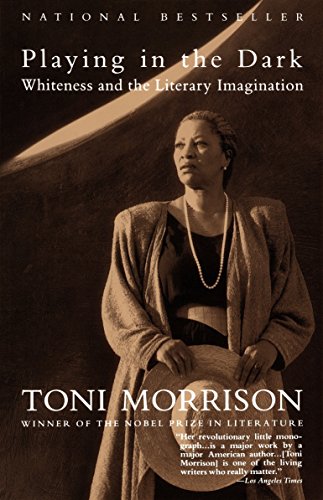
To answer this question, it might be instructive to turn to the words of Nobel Prize winner Toni Morrison, whose work as an English professor at an Ivy League university has compelled her to grapple with a canon of “great works” by almost exclusively white authors. In her book Playing in the Dark: Whiteness and Literary Imagination, she shares with us her discoveries about what she calls “African Americanism,” or “the ways in which a nonwhite or Africanlike (or Africanist) presence or persona was constructed in the US:”
American means white, and Africanist people struggle to make the term applicable to themselves with ethnicity and hyphen after hyphen after hyphen. Americans did not have a profligate, predatory nobility from which to wrest an identity of national virtue while continuing to covet aristocratic license and luxury… For the settlers and for American writers generally, this Africanist other became the means of thinking about body, mind, chaos, kindness, and love; provided the occasions for exercises in the absence of restraint, the presence of restraint, the contemplation of freedom and of aggression; permitted opportunities for the exploration of ethics and morality, for meeting the obligations of the social contract, for bearing the cross of religion and following out the ramifications of power.
 The names written on the floor of "The Dinner Party"
In other words, Morrison contends that racist depictions are not just oversights or unfortunate lapses on the part of the white artist to be circumvented like potholes in a road, but rather that these distorted characterizations inform the entire canon of values embodied in the work, being the very key to understanding the construction of the white artist's identity!
What does this mean for 1990's feminists approaching “The Dinner Table” today? It means that we should not flinch from confronting the treatment of women of color in the work. Far from shying away from these embarrassing seating arrangements, we should make them the centerpieces of our critical understanding of the work and of the movement it represented. The absence of women of color at the table is more than an unintentional oversight. It is a necessity for a feminist identity that informed and defined the entire guest list. Sojourner Truth's position at that table, according to Morrison's theory, provides the key to understanding the myths, the terrors, the denials, the strengths, the failures of that early feminist movement. The artist's unwillingness to grant, or inability to conceive, a symbolic vulva for a Black woman may be central to an entire definition of Western sexuality, of white women's sexual identity. Adopting Morrison's perspective and approach, one could argue that the Black and the First Nation's women's place at the table, and the exclusion of the Latina and Asian woman, could be the most historically significant aspects of “The Dinner Party.”
White radical feminists have vacillated between stonewalling and scapegoating when confronted with racist artifacts of the early Second Wave. Neither is a constructive strategy, and I suggest that we take Morrison's teaching to heart and begin to find ways to talk about our history that neither glosses over or trashes this very mixed heritage. A step in this direction would be to incorporate an acknowledgment and historical contextualizing of the racist treatment of women of color in any description of “The Dinner Party,” and especially in any press release designed to raise money for housing the project. As Morrison reminds us, “A criticism that needs to insist that literature is not only 'universal' but also 'race-free' risks lobotomizing that literature, and diminishes both the art and the artist."

 RSS Feed
